
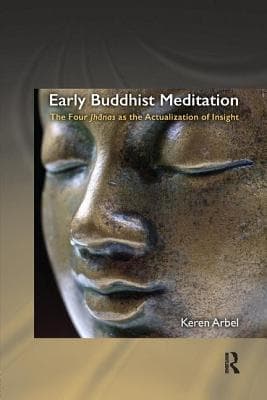
Early Buddhist Meditation: The Four Jhanas as the Actualization of Insight
by Arbel, Keren
Rent This Book
Returns in 60 days
Please Note: Rental books are typically used and do not come with any unused access code cards.
Free returns on all rentals
Product Details
About This Book
This book offers a new interpretation of the relationship between 'insight practice' (satipatthana) and the attainment of the four jh�nas (i.e., right sam�dhi), a key problem in the study of Buddhist meditation. The author challenges the traditional Buddhist understanding of the four jh�nas as states of absorption, and shows how these states are the actualization and embodiment of insight (vipassan�). It proposes that the four jh�nas and what we call 'vipassan�' are integral dimensions of a single process that leads to awakening.
Current literature on the phenomenology of the four jh�nas and their relationship with the 'practice of insight' has mostly repeated traditional Therav�da interpretations. No one to date has offered a comprehensive analysis of the fourfold jh�na model independently from traditional interpretations. This book offers such an analysis. It presents a model which speaks in the Nik�yas' distinct voice. It demonstrates that the distinction between the 'practice of serenity' (samatha-bh�van�) and the 'practice of insight' (vipassan�-bh�van�) - a fundamental distinction in Buddhist meditation theory - is not applicable to early Buddhist understanding of the meditative path. It seeks to show that the common interpretation of the jh�nas as 'altered states of consciousness', absorptions that do not reveal anything about the nature of phenomena, is incompatible with the teachings of the P�li Nik�yas.
By carefully analyzing the descriptions of the four jh�nas in the early Buddhist texts in P�li, their contexts, associations and meanings within the conceptual framework of early Buddhism, the relationship between this central element in the Buddhist path and 'insight meditation' becomes revealed in all its power.
Early Buddhist Meditation will be of interest to scholars of Buddhist studies, Asian philosophies and religions, as well as Buddhist practitioners with a serious interest in the process of insight meditation.