
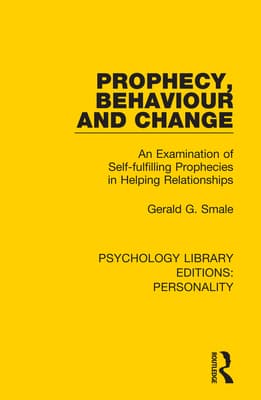
Prophecy, Behaviour and Change: An Examination of Self-fulfilling Prophecies in Helping Relationships
by Smale, Gerald G.
Rent This Book
Returns in 60 days
Please Note: Rental books are typically used and do not come with any unused access code cards.
Free returns on all rentals
Product Details
About This Book
Professional helpers may harm their clients instead of helping them. This is one of the important implications - for the selection, training and practice of members of the helping professions - of the evidence reviewed in this book. Originally published in 1977, Gerald Smale argues that the expectations of the professional helper, whether social worker, doctor, psychiatrist, psychoanalyst, psychotherapist or counsellor, can act as self-fulfilling prophecies on his or her clients, for better or worse.
In order to suggest how the expectations of the helper might operate, the author examines a three-stage model of self-fulfilling prophecies. The stages are: the prophecy; behaviour based upon the prophecy; the outcome brought about by the behaviour. Extensive evidence from the fields of experimenter bias, hypnosis and placebo medicine, psychotherapy, casework and counselling research, is reviewed and related to the model, and the relationship between this analysis and labelling theory is discussed.
The book demonstrates that it is the behaviour of the worker towards the client which is of crucial importance, and proposes that the client's future and his or her personal strengths should be an important focus of the helping relationship. Finally, it outlines the dangers of negative expectations, and emphasises the ways in which expectations can be used to optimum effect.