
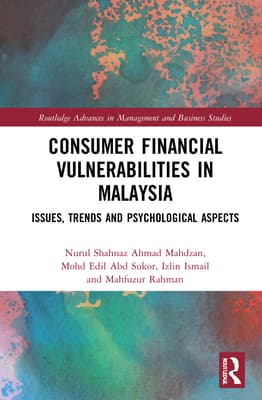
Consumer Financial Vulnerabilities in Malaysia: Issues, Trends and Psychological Aspects
by Ahmad Mahdzan, Nurul Shahnaz, Abd Sukor, Mohd Edil, Ismail, Izlin
Rent This Book
Returns in 60 days
Please Note: Rental books are typically used and do not come with any unused access code cards.
Free returns on all rentals
Product Details
About This Book
This book examines four aspects of Malaysian consumers' financial vulnerabilities. First, it discusses the issue of over-indebtedness due to excessive reliance on consumer financing. Second, the book investigates why Malaysians are ill-prepared for their golden years in terms of retirement planning and savings. Third, it delves into the problem of financial fraud victimisation among Malaysian consumers. Fourth, the book analyses the reasons why Malaysians are underinsured despite the distinct benefits of life insurance.
Drawing on secondary data from government agencies such as Bank Negara Malaysia, Employees' Provident Fund, Royal Malaysian Police and the Department of Statistics Malaysia, each chapter presents statistical trends reflecting the four financial vulnerabilities. In-depth analyses of the literature reveal three broad psychological domains (cognition, motivation, and disposition) and specific psychological factors (e.g. over-confidence, self-control, social norms, and financial literacy) that significantly influence consumers' financial decisions. The four financial vulnerabilities investigated in this book directly address the strategic outcomes of the Malaysian National Strategy for Financial Literacy 2019-2023 (MNSFL), a five-year plan to elevate the financial literacy of Malaysians. Finally, the book presents strategic recommendations that are believed to be useful guidelines for relevant policymakers to promote positive financial behaviours and rational attitudes among consumers.
It will be a useful resource for policymakers and researchers interested in economic psychology and behavioural finance.