
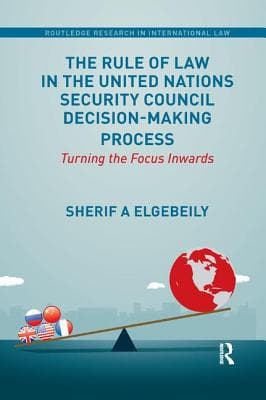
The Rule of Law in the United Nations Security Council Decision-Making Process: Turning the Focus Inwards
by Elgebeily, Sherif
Rent This Book
Returns in 60 days
Please Note: Rental books are typically used and do not come with any unused access code cards.
Free returns on all rentals
Product Details
About This Book
The UN Security Council is entrusted under the UN Charter with primary responsibility for the maintenance and restoration of the international peace; it is the only body with the power to authorise military intervention legally and impose international sanctions where it decides. However, its decision-making process has hitherto been obscure and allegations of political bias have been made against the Security Council in its responses to potential international threats. Despite the rule of law featuring on the Security Council's agenda for over a decade and a UN General Assembly declaration in 2012 establishing that the rule of law should apply internally to the UN, the Security Council has yet to formulate or incorporate a rule of law framework that would govern its decision-making process.
This book explains the necessity of a rule of law framework for the Security Council before analysing existing literature and UN documents on the domestic and international rule of law in search of concepts suitable for transposition to the arena of the Security Council. It emerges with eight core components, which form a bespoke rule of law framework for the Security Council. Against this framework, the Security Council's decision-making process since the end of the Cold War is meticulously evaluated, illustrating explicitly where and how the rule of law has been undermined or neglected in its behaviour. Ultimately, the book concludes that the Security Council and other bodies are unwilling or unable adequately to regulate the decision-making process against a suitable rule of law framework, and argues that there exists a need for the external regulation of Council practice and judicial review of its decisions.