
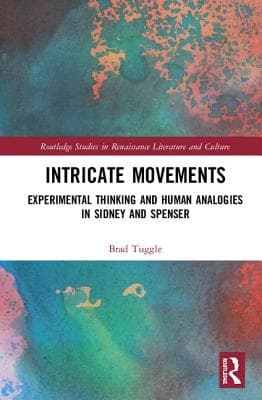
Intricate Movements: Experimental Thinking and Human Analogies in Sidney and Spenser
by Tuggle, Bradley Davin
Rent This Book
Returns in 60 days
Please Note: Rental books are typically used and do not come with any unused access code cards.
Free returns on all rentals
Product Details
About This Book
The recent vogue for posthumanist theory encourages a view of non-human objects and animals in Renaissance literature as pathways to essentially anti-humanist thought. On the contrary, this book argues that Sidney, Spenser, and their contemporaries employ animals, earth, buildings, and fictions as analogies employed toward a better understanding of what makes humans a special category, both ontologically and ethically. Horses and riders are studied by Sidney as a way to understand readers and writers; the 1580 Dover Straits Earthquake provides Spenser and Gabriel Harvey an opportunity to explore human emotion; liturgical spaces are represented by Sidney and Spenser in order to reassess human community; and fictional persons are interrogated by Spenser as models for human interpersonal epistemology.
This volume seeks to return critical assessments of the period's engagement with the non-human back to human concerns. Focusing on several early modern analogies between human and non-human entities, Intricate Movements argues Sidney's and Spenser's thinking about the human is both radically experimental and, ultimately, humane.