
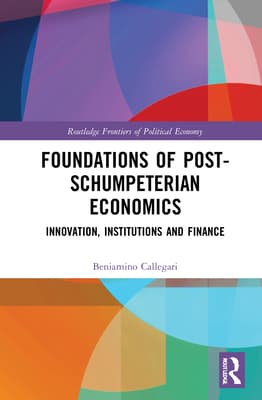
Foundations of Post-Schumpeterian Economics: Innovation, Institutions and Finance
by Callegari, Beniamino
Rent This Book
Returns in 60 days
Please Note: Rental books are typically used and do not come with any unused access code cards.
Free returns on all rentals
Product Details
About This Book
The neo-Schumpeterian interpretation dominating the field of evolutionary economics puts focus on technological innovation, Darwinian evolution and economic growth, and has proven to be fertile ground for the past forty years. However, as the evolutionary school attempts to engage with a world of inequality, financialization and economic fragility, the limits of such an interpretation begin to show. Contributing to the development of a more balanced post-Schumpeterian economics, this book offers a complementary interpretation of Schumpeter's theory which is based on economic innovation, Bergsonian creative evolution and monetary mechanisms and institutions.
The theoretical consequences of this new interpretation are significant and numerous. First, it leads to a conceptual separation of economic and technological innovation. Second, it offers a deeper integration of monetary and financial elements within the theory of the process of development, illustrating the adaptive and planning role provided by financial speculation under capitalist conditions. Third, it provides the foundations for a post-Schumpeterian theory of capitalist crisis, built on the relationship between innovation funding, the institutional development of banking and speculative credit creation. Finally, by discussing several key recent developments in evolutionary economics, the interpretation illustrates the opportunities unlocked by a pluralist approach to disciplinary development, aiming towards the development of a comprehensive post-Schumpeterian approach to economics.
This text is essential reading for scholars and students of Schumpeter, evolutionary economics, post-Keynesian economics, institutional economics and all economists interested in the ontological, methodological and theoretical challenges posed by economic development.