
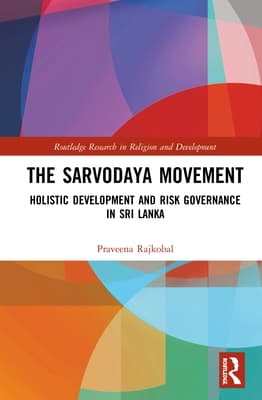
The Sarvodaya Movement: Holistic Development and Risk Governance in Sri Lanka
by Rajkobal, Praveena
Rent This Book
Returns in 60 days
Please Note: Rental books are typically used and do not come with any unused access code cards.
Free returns on all rentals
Product Details
About This Book
This book provides an important case study of how local cultures, religions and spiritualities can enhance development activities, and provide helpful frameworks for contemporary societies facing the pressures of neo-liberalism. It specifically traces how the influential Sri Lankan Sarvodaya Movement has deployed concepts of spirituality-based holistic development to help local communities with post-tsunami reconstruction and redevelopment.
Throughout, the author provides a Three-Sphere conceptualisation of holistic sustainable development, focused on Culture, Economics and Power, slightly revising Sarvodaya's Three-Sphere model comprising Spirituality, Economics and Power. The author contends that the success of holistic development, including risk governance, is largely contingent on an awareness of the interdependency of these three spheres, and establishing equitable partnerships between communities, NGOs, INGOs, States and the private sector. Overall, this book argues that religion, spirituality and non-religious worldviews play an important role among other resources concerned with how to survive the pressures of neo-liberalism and environmental risks and crises.
The Sarvodaya Movement, which draws on Buddhist concepts of spirituality, is widely acknowledged as an important example of spirituality and community-driven development, and as such, this book will be of interest to scholars of Development and Humanitarian Studies, Religious Studies and South Asian Studies.