
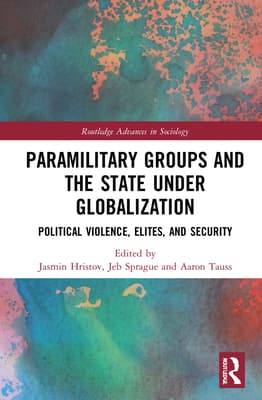
Paramilitary Groups and the State Under Globalization: Political Violence, Elites, and Security
by Hristov, Jasmin, Sprague, Jeb, Tauss, Aaron
Rent This Book
Returns in 60 days
Please Note: Rental books are typically used and do not come with any unused access code cards.
Free returns on all rentals
Product Details
About This Book
This book examines the phenomenon of paramilitarism across Latin America and the Caribbean, Eastern Europe, Africa, and Asia, offering a nuanced perspective while identifying key patterns in the way paramilitary violence is implicated in processes of capital accumulation, state-building, and the reproduction of social power.
Paramilitary violence, a key modality of coercion in the era of globalization, has been pursued by states and dominant classes in the Global South, to reproduce or extend their power over subaltern groups. Paramilitary groups are responsible for atrocities, including extrajudicial executions, disappearances, torture, rape, and forced displacement. The book integrates empirically rich investigations into an emergent theory of political violence, capturing the relationship between parastatal armed actors, capital, and the state.
The analysis sheds light on globally relevant phenomena such as the end of the Cold War, the shifting role of US hegemony, and evolving nature of the nation-state. The book is suitable for academics, graduate and upper-year undergraduate students, and policy-makers in development, human rights, and violence prevention. Given its interdisciplinary subject, it appeals to scholars from a wide range of disciplines, including political science, sociology, political anthropology, development, peace and conflict, security and terrorism, international relations, and global studies.