
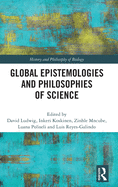
Global Epistemologies and Philosophies of Science
by David Ludwig (Editor), Inkeri Koskinen (Editor), Zinhle Mncube (Editor), Luana Poliseli (Editor), Luis Reyes-Galindo (Editor)
Rent This Book
Returns in 60 days
Please Note: Rental books are typically used and do not come with any unused access code cards.
Free returns on all rentals
Product Details
About This Book
In bringing together a global community of philosophers, Global Epistemologies and Philosophies of Science develops novel perspectives on epistemology and philosophy of science by demonstrating how frameworks from academic philosophy (e.g. standpoint theory, social epistemology, feminist philosophy of science) and related fields (e.g. decolonial studies, transdisciplinarity, global history of science) can contribute to critical engagement with global dimensions of knowledge and science.
Global challenges such as climate change, food production, and infectious diseases raise complex questions about scientific knowledge production and its interactions with local knowledge systems and social realities. As academic philosophy provides relatively little reflection on global negotiations of knowledge, many pressing scientific and societal issues remain disconnected from core debates in epistemology and philosophy of science.
This book is an invitation to broaden agendas of academic philosophy by presenting epistemology and philosophy of science as globally engaged fields that address heterogeneous forms of knowledge production and their interactions with local livelihoods, practices, and worldviews. This integrative ambition makes the book equally relevant for philosophers and interdisciplinary scholars who are concerned with methodological and political challenges at the intersection of science and society.