
HomeLibraryRule of Law, Common Values, and Illiberal Constitutionalism: Poland and Hungary Within the European Union
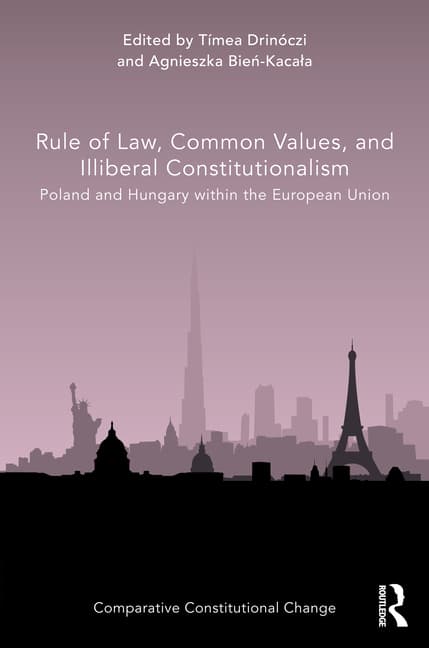
ISBN-13: 9780367512125
Hardcover
242 Pages
Rule of Law, Common Values, and Illiberal Constitutionalism: Poland and Hungary Within the European Union
by Tímea Drinóczi (Editor), Agnieszka Bień-Kacala (Editor)
Rent This Book
Returns in 60 days
$92.17/ 60 days
Please Note: Rental books are typically used and do not come with any unused access code cards.
Free returns on all rentals
Product Details
ISBN-139780367512125
ISBN-100367512122
PublisherRoutledge
Published2020-09-09
Edition1
LanguageEnglish
FormatHardcover
Pages242
About This Book
This book challenges the idea that the Rule of Law is still a universal European value given its relatively rapid deterioration in Hungary and Poland, and the apparent inability of the European institutions to adequately address the illiberalization of these Member States. The book begins from the general presumption that the Rule of Law, since its emergence, has been a universal European value, a political ideal and legal conception. It also acknowledges that the EU has been struggling in the area of value enforcement, even if the necessary mechanisms are available and, given an innovative outlook and more political commitment, could be successfully used. The authors appreciate the different approaches toward the Rule of Law, both as a concept and as a measurable indicator, and while addressing the core question of the volume, widely rely on them. Ultimately, the book provides a snapshot of how the Rule of Law ideal has been dismantled and offers a theory of the Rule of Law in illiberal constitutionalism. It discusses why voters keep illiberal populist leaders in power when they are undeniably acting contrary to the Rule of Law ideal. The book will be of interest to academics and researchers engaged with the foundational questions of constitutionalism. The structure and nature of the subject matter covered ensure that the book will be a useful addition for comparative and national constitutional law classes. It will also appeal to legal practitioners wondering about the boundaries of the Rule of Law.