
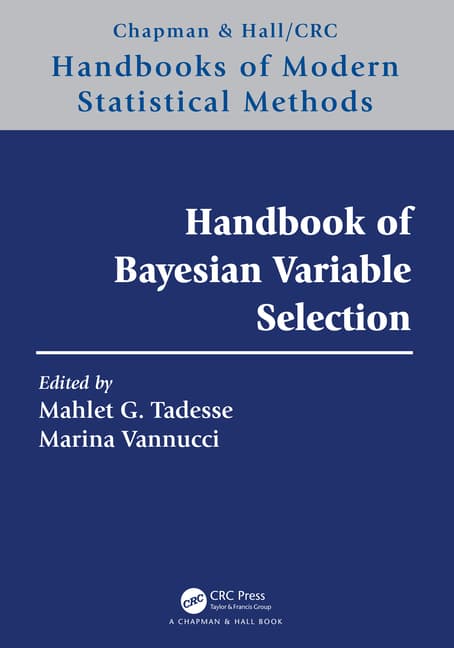
Handbook of Bayesian Variable Selection
by Mahlet G Tadesse (Editor), Marina Vannucci (Editor)
Rent This Book
Returns in 60 days
Please Note: Rental books are typically used and do not come with any unused access code cards.
Free returns on all rentals
Product Details
About This Book
Bayesian variable selection has experienced substantial developments over the past 30 years with the proliferation of large data sets. Identifying relevant variables to include in a model allows simpler interpretation, avoids overfitting and multicollinearity, and can provide insights into the mechanisms underlying an observed phenomenon. Variable selection is especially important when the number of potential predictors is substantially larger than the sample size and sparsity can reasonably be assumed.
The Handbook of Bayesian Variable Selection provides a comprehensive review of theoretical, methodological and computational aspects of Bayesian methods for variable selection. The topics covered include spike-and-slab priors, continuous shrinkage priors, Bayes factors, Bayesian model averaging, partitioning methods, as well as variable selection in decision trees and edge selection in graphical models. The handbook targets graduate students and established researchers who seek to understand the latest developments in the field. It also provides a valuable reference for all interested in applying existing methods and/or pursuing methodological extensions.
Features:
- Provides a comprehensive review of methods and applications of Bayesian variable selection.
- Divided into four parts: Spike-and-Slab Priors; Continuous Shrinkage Priors; Extensions to various Modeling; Other Approaches to Bayesian Variable Selection.
- Covers theoretical and methodological aspects, as well as worked out examples with R code provided in the online supplement.
- Includes contributions by experts in the field.
- Supported by a website with code, data, and other supplementary material