
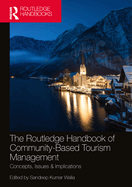
The Routledge Handbook of Community Based Tourism Management: Concepts, Issues & Implications
by Sandeep Kumar Walia (Editor)
Rent This Book
Returns in 60 days
Please Note: Rental books are typically used and do not come with any unused access code cards.
Free returns on all rentals
Product Details
About This Book
This Handbook offers an up-to-date and comprehensive overview of core themes and concepts in community-based tourism management. Providing interdisciplinary insights from leading international scholars, this is the first book to critically examine the current status of community-based tourism.
Organised into five parts, the Handbook provides cutting-edge perspectives on issues such as Indigenous communities, tourism and the environment, sustainability, and the impact of digital communities. Part 1 introduces core concepts and methodologies, and distinguishes community products from other tourism and hospitality goods. Part 2 explores communities' attitudes towards tourism development and their engagement with and ownership of the process. It also delves into the role of community- based tourism, under the influence of governmental policies, in the economic and social development of a region. In Part 3 various management, marketing, and branding initiatives are identified as a means of expanding the tourism business. Part 4 examines the negative impacts of mass tourism and its threats to culture, tradition, identity, the built environment, and natural heritage. In the final and fifth part, future challenges and opportunities for community-based tourism initiatives are considered, and research-based sustainable solutions are proposed. Overall, the book considers engaging local populations in tourism development as a way of building stronger and more resilient communities.
This Handbook fills a void in the current research and thus will appeal to scholars, students, and practitioners interested in tourism management, tourism geography, business studies, development policy and practice, regional development, conservation, and sustainability.