
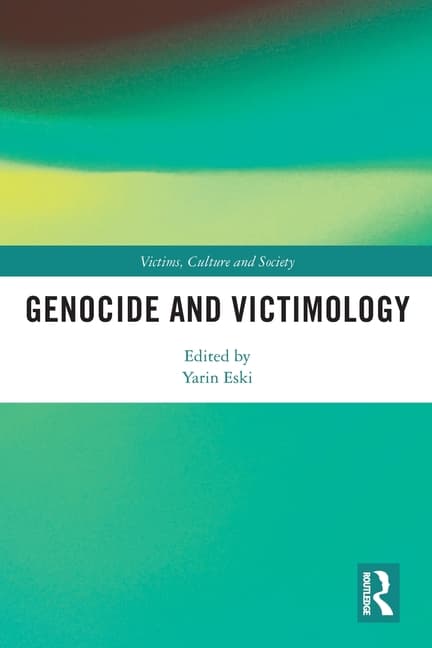
Genocide and Victimology
by Yarin Eski (Editor)
Rent This Book
Returns in 60 days
Please Note: Rental books are typically used and do not come with any unused access code cards.
Free returns on all rentals
Product Details
About This Book
Genocide and Victimology examines genocide in its diverse features, from different yet connected perspectives, to offer an interdisciplinary, victimological imagination of genocide. It will include in its exploration critical and cultural victimologies and criminologies of genocide, accompanied by, and recognising, the rich scholarship on genocide in the fields of religion and history, theatre studies and photography, philosophy and existentialism, post-colonialism, and ethnography and biography.
Bringing together theory with empirical research and drawing on a range of case studies, such as the Treblinka extermination camp, the Bosnian and Rwandan genocides, the Sagkeeng First Nation in Manitoba, Canada, and genocidal violence in Syria and Iraq, this book engages the victimological imagination towards an interdisciplinary, cosmopolitan victimology of genocide. Bundled and intertwined, the wide yet integrated variety of perspectives on genocide gives readers a victimological kaleidoscope to discover, and for victimology hitherto, unexplored theory and methodology. This way, readers can develop their own more epistemologically, theoretically, and methodologically robust victimology of genocide--a victimology of genocide as envisioned by Nicole Rafter. The book hopes to canvas an understanding and a starting point for a diverse appreciation of genocide victimhood and survivorship from which the real post-genocidal harms and sites, post-traumatic stress disorder, courts and tribunals, and overall meaningful justice will benefit.
Written in a clear and direct style, this book will appeal to students and scholars in criminology, sociology, cultural studies, philosophy, history, religious studies, English literature, and all those concerned with not repeating a history of genocide.