
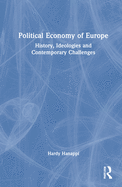
Political Economy of Europe: History, Ideologies and Contemporary Challenges
by Hardy Hanappi
Rent This Book
Returns in 60 days
Please Note: Rental books are typically used and do not come with any unused access code cards.
Free returns on all rentals
Product Details
About This Book
The development of European unification has reached a critical stage. Despite 75 years of peace, increases in welfare, and growth since World War 2, there is now a growing scepticism of the European agenda from various quarters, most notably embodied in the exit of the United Kingdom from the European Union. To fully understand the dynamics at work, this book presents an introduction to the development of the political economy of Europe from 1900 to 2020.
The first part of the book provides an overview of European economic and political history from 1900 to the present. It is clear from this history that Europe's population, and most notably its leaders, have been deeply influenced by ideology during this time. This sets the context for the second part of the book, which takes a closer look at some major paradigms framing European dynamics: (1) the market-oriented paradigm, (2) Marx's paradigm, and (3) the fascist paradigm. In this part, the essential core of each of these paradigms is presented and critiqued. In the third part, the current bottlenecks of European evolution (the migration crisis, Brexit, rise of new Fascism, the climate crisis, the COVID-19 pandemic) are investigated in the light of a possible emergence of a new scientific paradigm. Europe's role in the global division of labour - its possibility to serve as a role model for the advantages of democratically governing a highly diverse set of populations - is also explained.
This book is an ideal text for students undertaking courses on the political economy of Europe in either economics or politics departments.