
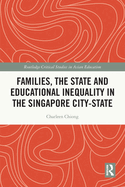
Families, the State and Educational Inequality in the Singapore City-State
by Charleen Chiong
Rent This Book
Returns in 60 days
Please Note: Rental books are typically used and do not come with any unused access code cards.
Free returns on all rentals
Product Details
About This Book
Focusing on Singapore's education system from an equity perspective, Chiong's book describes the often unheard perspectives of socio-economically disadvantaged families in Singapore. The performance of Singaporean students on international education benchmarking tests has been widely recognised. Relatively less known is how socio-economically disadvantaged families negotiate Singapore's highly competitive, stratifying and meritocratic system. Yet, families' perspectives can provide crucial insight in understanding how policy is 'lived' and experienced, and its effects on people's lives.
Drawing on 72 interviews with 12 families, this book traces the development of surprisingly close, collaborative relations between the state, schools and families on Singapore's socio-economic margins. It demonstrates that in the 'strong' state of Singapore, families' dependency on schools and the state facilitates the internalisation of individual and familial responsibility for future success. However, these very processes can injure, and perpetuate inequality.
The analysis presented in this book has relevance in other contexts, in times where advanced capitalist states face growing inequalities and challenging relationships between institutional authority and the wider populace. As socio-economic and educational inequalities widen, this book asks timely questions and provides recommendations on what a more equitable state-citizen compact might look like.
The book will appeal to researchers and students who are interested in the fields of the sociology and politics of education, social policy, and Asian culture and society.