
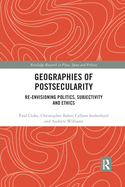
Geographies of Postsecularity: Re-Envisioning Politics, Subjectivity and Ethics
by Paul Cloke, Christopher Baker, Callum Sutherland, Andrew Williams
Rent This Book
Returns in 60 days
Please Note: Rental books are typically used and do not come with any unused access code cards.
Free returns on all rentals
Product Details
About This Book
This book explores the hopeful possibility that emerging geographies of postsecularity are able to contribute significantly to the understanding of how common life may be shared, and how caring for the common goods of social justice, well-being, equality, solidarity and respect for difference may be imagined and practiced. Drawing on recent geographic theory to recalibrate ideas of the postsecular public sphere, the authors develop the case for postsecularity as a condition of being that is characterised by practices of receptive generosity, rapprochement between religious and secular ethics, and a hopeful re-enchantment and re-shaping of desire towards common life. The authors highlight the contested formation of ethical subjectivity under neoliberalism and the emergence of postsecularity within this process as an ethically-attuned politics which changes relations between religion and secularity and animates novel, hopeful imaginations, subjectivities, and praxes as alternatives to neoliberal norms. The spaces and subjectivities of emergent postsecularity are examined through a series of innovative case studies, including food banks, drug and alcohol treatment, refugee humanitarian activism in Calais, homeless participatory art projects, community responses to the Christchurch earthquakes in New Zealand, amongst others. The book also traces the global conditions for postsecularity beyond the Western and predominantly Christian-secular nexus of engagement.
This is a valuable resource for students in several academic disciplines, including geography, sociology, politics, religious studies, international development and anthropology. It will be of great interest to secular and faith-based practitioners working in religion, spirituality, politics or more widely in public policy, urban planning and community development.