
HomeLibraryIntroduction to Mediation, Moderation, and Conditional Process Analysis: A Regression-Based Approach
ISBN-13: 9781462549030
Hardcover
732 Pages
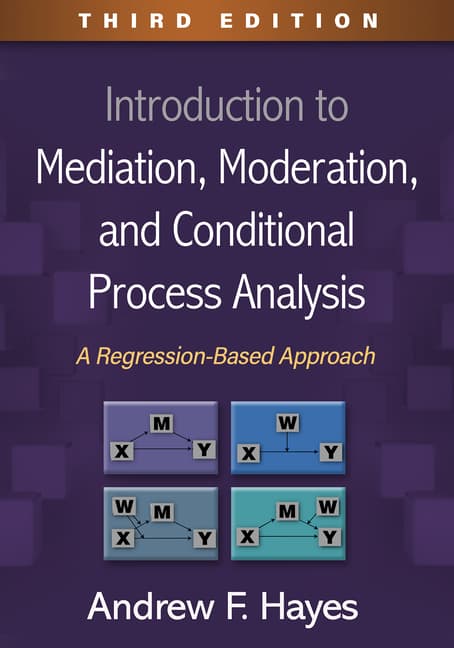
Introduction to Mediation, Moderation, and Conditional Process Analysis: A Regression-Based Approach
by Andrew F Hayes
Rent This Book
Returns in 60 days
$44.65/ 60 days
Please Note: Rental books are typically used and do not come with any unused access code cards.
Free returns on all rentals
Product Details
ISBN-139781462549030
ISBN-101462549039
PublisherGuilford Publications
Published2022-01-24
Edition3
LanguageEnglish
FormatHardcover
Pages732
About This Book
Acclaimed for its thorough presentation of mediation, moderation, and conditional process analysis, this book has been updated to reflect the latest developments in PROCESS for SPSS, SAS, and, new to this edition, R. Using the principles of ordinary least squares regression, Andrew F. Hayes illustrates each step in an analysis using diverse examples from published studies, and displays SPSS, SAS, and R code for each example. Procedures are outlined for estimating and interpreting direct, indirect, and conditional effects; probing and visualizing interactions; testing hypotheses about the moderation of mechanisms; and reporting different types of analyses. Readers gain an understanding of the link between statistics and causality, as well as what the data are telling them. The companion website (www.afhayes.com) provides data for all the examples, plus the free PROCESS download. New to This Edition
- Rewritten Appendix A, which provides the only documentation of PROCESS, including a discussion of the syntax structure of PROCESS for R compared to SPSS and SAS.
- Expanded discussion of effect scaling and the difference between unstandardized, completely standardized, and partially standardized effects.
- Discussion of the meaning of and how to generate the correlation between mediator residuals in a multiple-mediator model, using a new PROCESS option.
- Discussion of a method for comparing the strength of two specific indirect effects that are different in sign.
- Introduction of a bootstrap-based Johnson-Neyman-like approach for probing moderation of mediation in a conditional process model.
- Discussion of testing for interaction between a causal antecedent variable [ital]X[/ital] and a mediator [ital]M[/ital] in a mediation analysis, and how to test this assumption in a new PROCESS feature.