
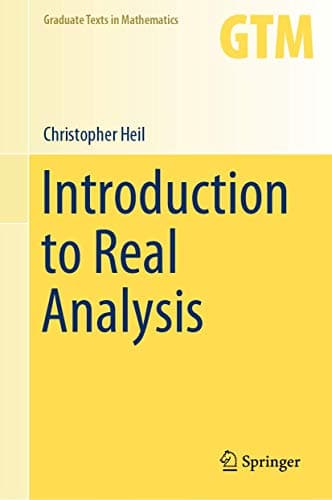
ISBN-13: 9783030269012
Hardcover
418 Pages
Introduction to Real Analysis (Graduate Texts in Mathematics (280))
by Robert G. Bartle, Donald R. Sherbert, Manfred Stoll, Michael J. Schramm, Christopher Heil
Availability Unavailable
This book is not currently available for rent or purchase.
Product Details
ISBN-139783030269012
ISBN-103030269019
PublisherSpringer
Published2019-07-30
Edition1
LanguageEnglish
FormatHardcover
Pages418
About This Book
Developed over years of classroom use, this textbook provides a clear and accessible approach to real analysis. This modern interpretation is based on the author’s lecture notes and has been meticulously tailored to motivate students and inspire readers to explore the material, and to continue exploring even after they have finished the book. The definitions, theorems, and proofs contained within are presented with mathematical rigor, but conveyed in an accessible manner and with language and motivation meant for students who have not taken a previous course on this subject.
The text covers all of the topics essential for an introductory course, including Lebesgue measure, measurable functions, Lebesgue integrals, differentiation, absolute continuity, Banach and Hilbert spaces, and more. Throughout each chapter, challenging exercises are presented, and the end of each section includes additional problems. Such an inclusive approach creates an abundance of opportunities for readers to develop their understanding, and aids instructors as they plan their coursework. Additional resources are available online, including expanded chapters, enrichment exercises, a detailed course outline, and much more.
Introduction to Real Analysis is intended for first-year graduate students taking a first course in real analysis, as well as for instructors seeking detailed lecture material with structure and accessibility in mind. Additionally, its content is appropriate for Ph.D. students in any scientific or engineering discipline who have taken a standard upper-level undergraduate real analysis course.