
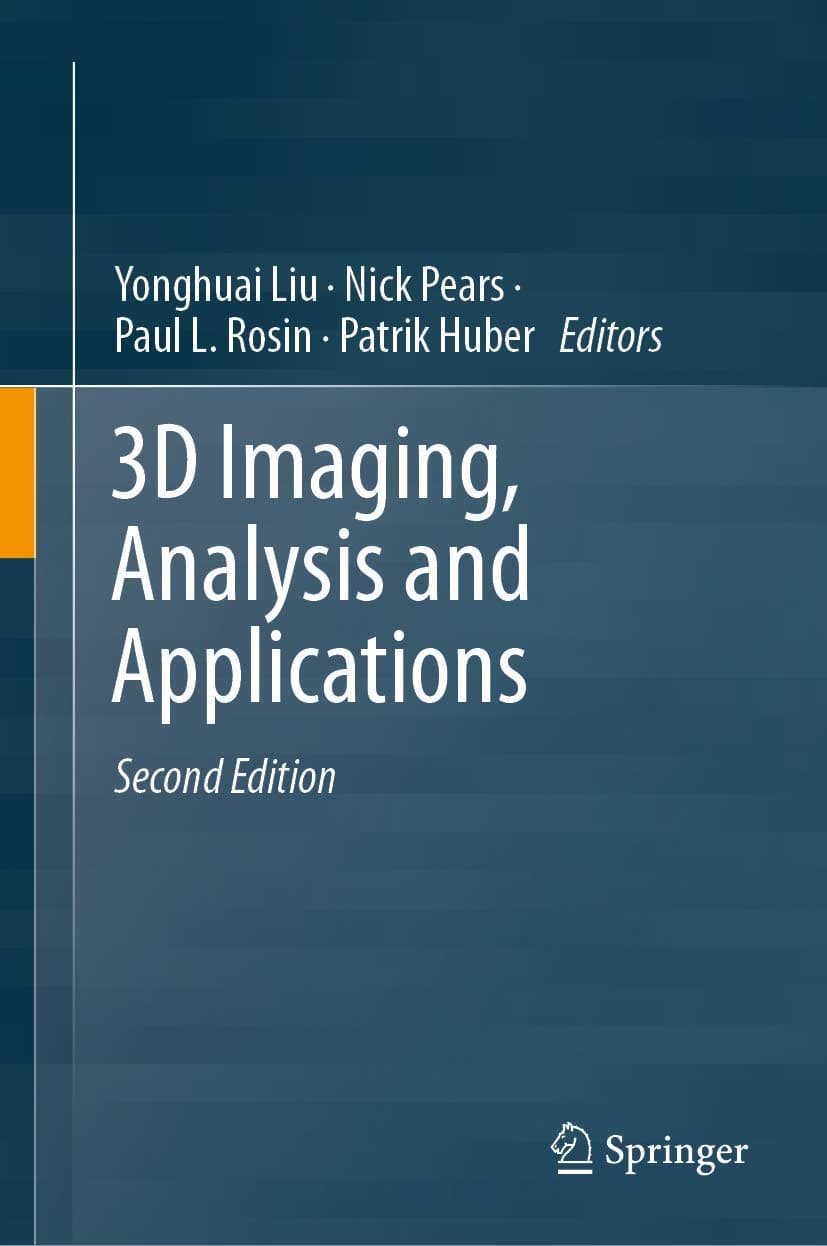
3D Imaging, Analysis and Applications (2020)
by
Rent This Book
Returns in 60 days
Please Note: Rental books are typically used and do not come with any unused access code cards.
Free returns on all rentals
Product Details
About This Book
This textbook is designed for postgraduate studies in the field of 3D Computer Vision. It also provides a useful reference for industrial practitioners; for example, in the areas of 3D data capture, computer-aided geometric modelling and industrial quality assurance. This second edition is a significant upgrade of existing topics with novel findings. Additionally, it has new material covering consumer-grade RGB-D cameras, 3D morphable models, deep learning on 3D datasets, as well as new applications in the 3D digitization of cultural heritage and the 3D phenotyping of crops.
Overall, the book covers three main areas:
● 3D imaging, including passive 3D imaging, active triangulation 3D imaging, active time-of-flight 3D imaging, consumer RGB-D cameras, and 3D data representation and visualisation;
● 3D shape analysis, including local descriptors, registration, matching, 3D morphable models, and deep learning on 3D datasets; and
● 3D applications, including 3D face recognition, cultural heritage and 3D phenotyping of plants.
3D computer vision is a rapidly advancing area in computer science. There are many real-world applications that demand high-performance 3D imaging and analysis and, as a result, many new techniques and commercial products have been developed. However, many challenges remain on how to analyse the captured data in a way that is sufficiently fast, robust and accurate for the application. Such challenges include metrology, semantic segmentation, classification and recognition. Thus, 3D imaging, analysis and their applications remain a highly-active research field that will continue to attract intensive attention from the research community with the ultimate goal of fully automating the 3D data capture, analysis and inference pipeline.