
HomeLibraryCryostat Design: Case Studies, Principles and Engineering (International Cryogenics Monograph Series)
ISBN-13: 9783319311487
Hardcover
297 Pages
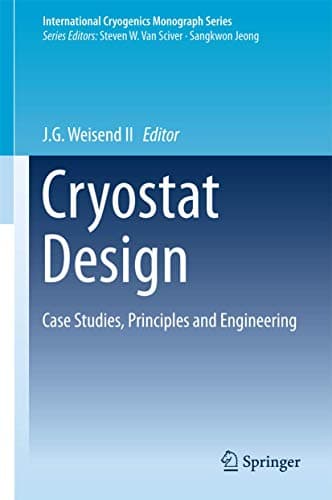
Cryostat Design: Case Studies, Principles and Engineering (International Cryogenics Monograph Series)
by Martin Donabedian, David G. Gilmore, Neil E. Todreas, Gene Cogorno, J.G. Weisend II
Availability Unavailable
This book is not currently available for rent or purchase.
Product Details
ISBN-139783319311487
ISBN-103319311484
PublisherSpringer
Published2016-08-22
Edition1
LanguageEnglish
FormatHardcover
Pages297
About This Book
This book enables the reader to learn the fundamental and applied aspects of practical cryostat design by examining previous design choices and resulting cryostat performance. Through a series of extended case studies the book presents an overview of existing cryostat design covering a wide range of cryostat types and applications, including the magnet cryostats that comprise the majority of the Large Hadron Collider at CERN, space-borne cryostats containing sensors operating below 1 K, and large cryogenic liquid storage vessels.
It starts with an introductory section on the principles of cryostat design including practical data and equations. This section is followed by a series of case studies on existing cryostats, describing the specific requirements of the cryostat, the challenges involved and the design choices made along with the resulting performance of the cryostat. The cryostat examples used in the studies are chosen to cover a broad range of cryostatapplications and the authors of each case are leading experts in the field, most of whom participated in the design of the cryostats being described. The concluding chapter offers an overview of lessons learned and summarises some key hints and tips for practical cryostat design.
The book will help the reader to expand their knowledge of many disciplines required for good cryostat design, including the cryogenic properties of materials, heat transfer and thermal insulation, instrumentation, safety, structures and seals.