
ISBN-13: 9783527334155
Hardcover
750 Pages
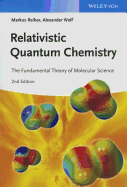
Relativistic Quantum Chemistry: The Fundamental Theory of Molecular Science (Revised)
by Markus Reiher, Alexander Wolf
Rent This Book
Returns in 60 days
$87.57/ 60 days
Please Note: Rental books are typically used and do not come with any unused access code cards.
Free returns on all rentals
Product Details
ISBN-139783527334155
ISBN-103527334157
PublisherWiley-Vch
Published2014-12-31
Edition2
LanguageEnglish
FormatHardcover
Pages750
About This Book
Einstein proposed his theory of special relativity in 1905. For a long time it was believed that this theory has no significant impact on chemistry. This view changed in the 1970s when it was realized that (nonrelativistic) Schrodinger quantum mechanics yields results on molecular properties that depart significantly from experimental results. Especially when heavy elements are involved, these quantitative deviations can be so large that qualitative chemical reasoning and understanding is affected. For this to grasp the appropriate many-electron theory has rapidly evolved. Nowadays relativistic approaches are routinely implemented and applied in standard quantum chemical software packages. As it is essential for chemists and physicists to understand relativistic effects in molecules, the first edition of "Relativistic Quantum Chemistry - The fundamental Theory of Molecular Science" had set out to provide a concise, comprehensive, and complete presentation of this theory. This second edition expands on some of the latest developments in this fascinating field. The text retains its clear and consistent style, allowing for a readily accessible overview of the complex topic. It is also self-contained, building on the fundamental equations and providing the mathematical background necessary. While some parts of the text have been restructured for the sake of clarity a significant amount of new content has also been added. This includes, for example, an in-depth discussion of the Brown-Ravenhall disease, of spin in current-density functional theory, and of exact two-component methods and its local variants.
A strength of the first edition of this textbook was its list of almost 1000 references to the original research literature, which has made it a valuable reference also for experts in the field. In the second edition, more than 100 additional key references have been added - most of them considering the recent developments in the field.
Thus, the book is a must-have for everyone entering the field, as well as for experienced researchers searching for a consistent review.
A strength of the first edition of this textbook was its list of almost 1000 references to the original research literature, which has made it a valuable reference also for experts in the field. In the second edition, more than 100 additional key references have been added - most of them considering the recent developments in the field.
Thus, the book is a must-have for everyone entering the field, as well as for experienced researchers searching for a consistent review.